
Last updated November 16, 2026
 AC repair
 Furnace & heating
 Heat pumps
 Ductless mini splits
 Carrier
 Trane
 Goodman
Seasonal tune-up and full diagnostic on your Carrier, Trane, or Goodman system - readings shown to you before any repair is proposed
Diagnosis first, numbers second - you approve the repair price before a single part goes in.
Get your free estimateAC Installation Troubleshooting in Inglewood: Common Problems and How to Fix Them
Your new air conditioner was installed three weeks ago and something feels off. It runs constantly. One room never gets comfortable. Or your first electric bill came in noticeably higher than you expected. Nine times out of ten, that’s not a defective unit sitting on your roof or in your side yard. It’s a fixable installation mistake, and you have real leverage to get it corrected at no cost if you know what to look for and how to document it. This guide shows Inglewood homeowners how to identify the five most common post-installation symptoms, describe them accurately to the installer, and know exactly who is responsible for fixing what.
Quick Answer
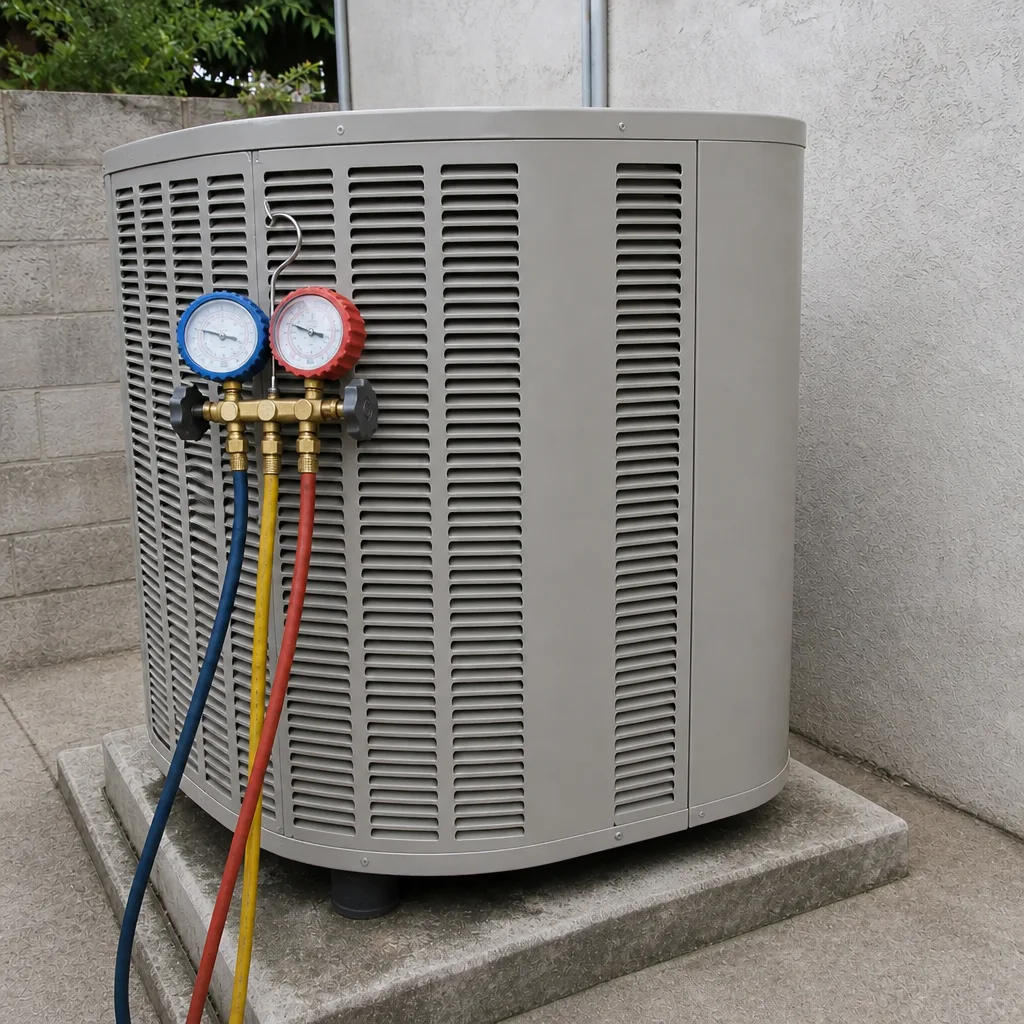
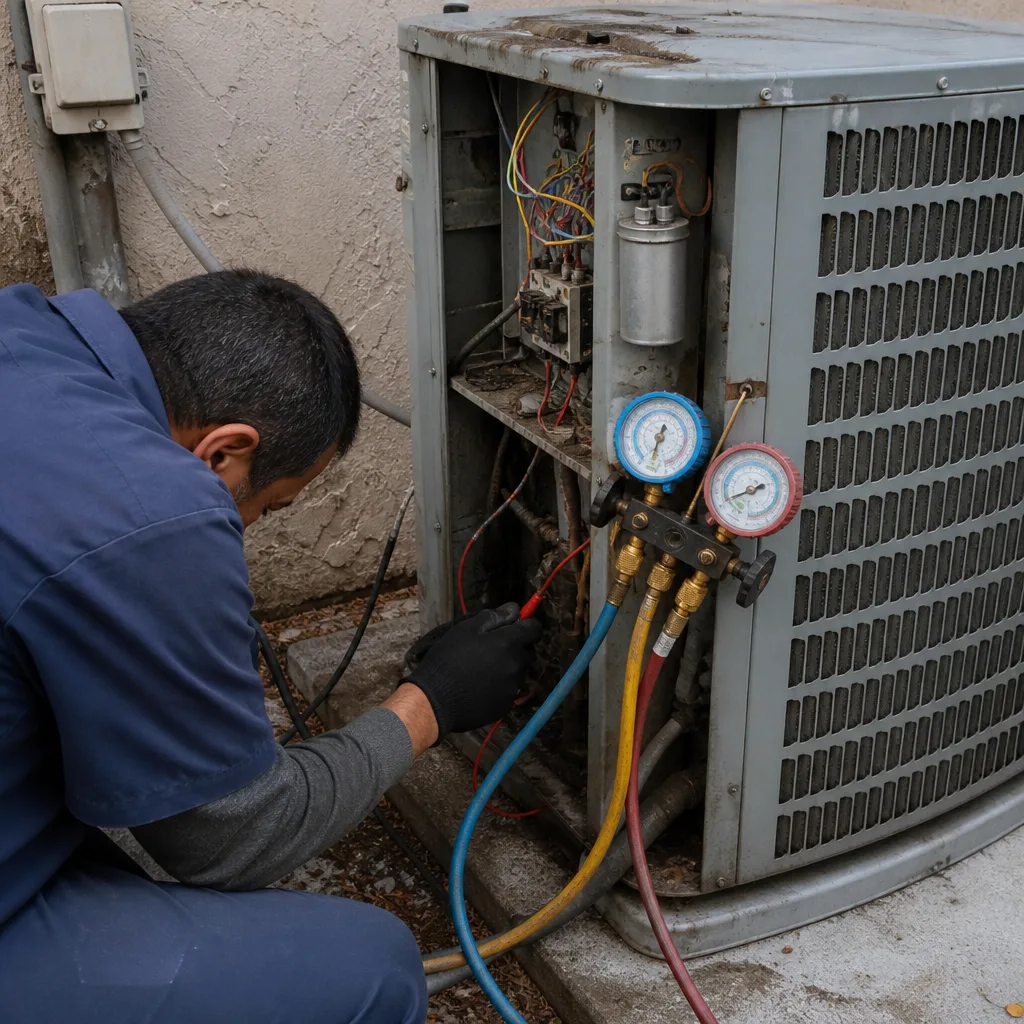
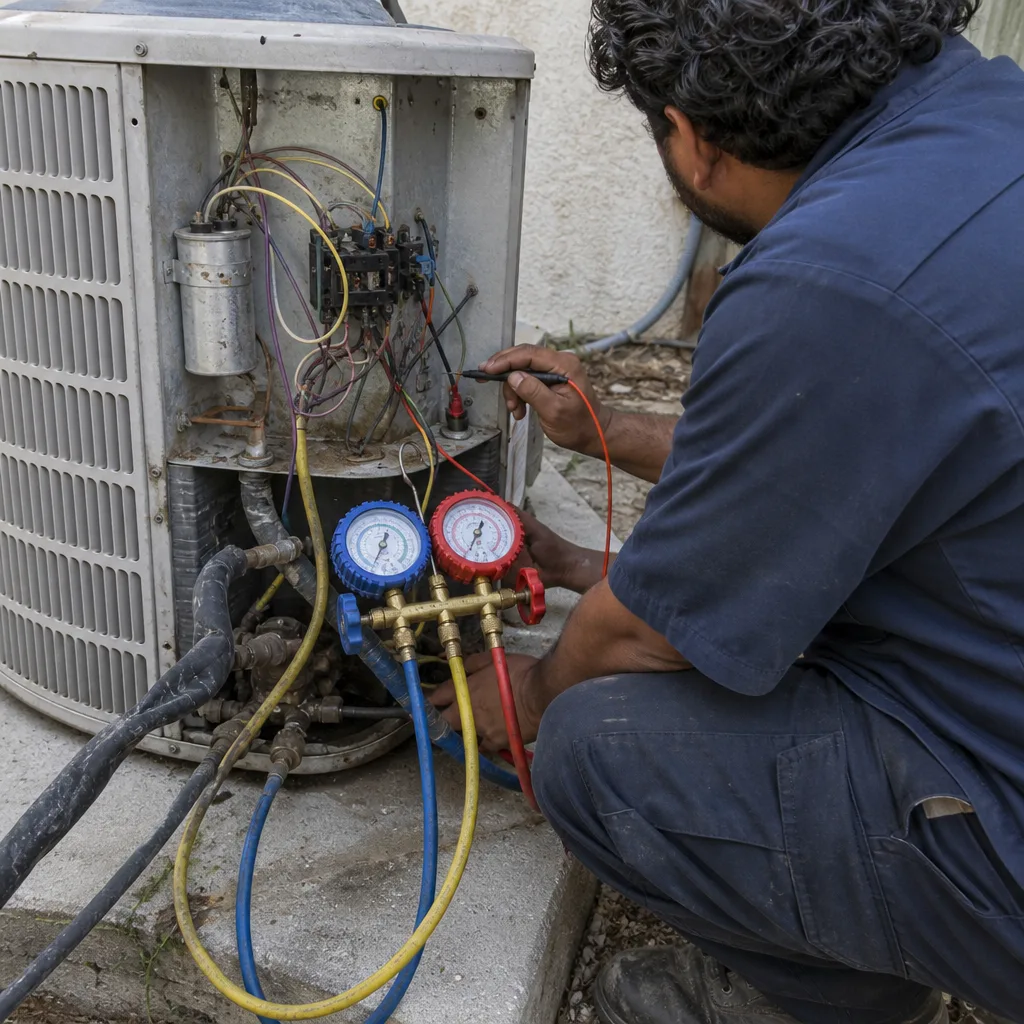
Most post-installation AC problems in Inglewood are installation errors, not equipment failures. They show up 30 to 90 days after the job, and the most common ones are improper refrigerant charge, undersized or poorly sealed ductwork, short cycling from an oversized unit, and airflow restrictions at the return. Document the symptoms with dates and thermostat readings, then call the installer back in writing before the warranty window narrows. A trained technician with manifold gauges can confirm refrigerant charge in about 20 minutes.
Styles & brands we work with
- AC repair
- Furnace & heating
- Heat pumps
- Ductless mini splits
- Carrier
- Trane
- Goodman
Table of Contents
- Why installation problems show up 30 to 90 days later
- The five most common post-installation symptoms and what they mean
- Improper refrigerant charge: the invisible installation error
- How to read your thermostat and air handler to build a factual case
- What your City of Inglewood permit inspection catches and what it misses
- Warranty call versus installer callback: how to phrase the conversation
- When to repair and when to replace
- Common mistakes to avoid
Why do installation problems show up 30 to 90 days later?
An air conditioner that runs in August is a machine under stress. Airflow, refrigerant pressure, and electrical draw all push against each other, and small installation errors that don’t show up on a first-day test run will reveal themselves once the system runs hard for a few weeks. A system charged 10 percent under spec may cool fine on an 80-degree afternoon and struggle on a 95-degree one. Ductwork sealed with a thin bead of mastic may hold for the first month and then leak at a joint that flexes under vibration. A unit sized one half-ton too large for the room it serves will cool the space quickly and shut off before it dehumidifies, leaving a room that feels cool and clammy at the same time – and a homeowner convinced something is broken.
This timing matters because it’s also when your installation warranty and the installer’s callback window are at their most generous. If you wait eight months to report a problem, you’re arguing about what happened three seasons ago instead of what happened three weeks ago. In our experience across Inglewood, the homeowners who get installation problems fixed at no charge are the ones who called back within the first two months with a written list of symptoms and dates, not the ones who waited for the system to fail completely.
What are the five most common post-installation symptoms in Inglewood homes?
Here’s what we see most often, and what each symptom actually points to. Print this list and keep it near the thermostat.
1. Short cycling (system turns on and off every 5 to 15 minutes)
Short cycling usually means the unit is oversized for the space, the thermostat is located where it reads hot air bouncing off a wall or window, or the system is low on refrigerant and shutting down on a low-pressure safety. In an older Inglewood home with original single-pane windows and little insulation, a contractor who sized the unit off square footage alone rather than a room-by-room load calculation will almost always oversize it. The result is a system that cools fast, shuts off before removing humidity, and restarts 10 minutes later. That’s a comfort problem, not an equipment failure, and it’s fixable – often with a thermostat relocation or a re-check of the load calculation.
2. Uneven cooling (one room never gets comfortable)
A room that stays 5 to 8 degrees warmer than the rest of the house almost always traces back to ductwork, not the condenser. Undersized supply runs, crushed flexible duct behind a wall, or a return air path that starves the far rooms of pressure are the usual culprits. Ask the installer for a room-by-room airflow reading. If they can’t produce one, that’s your first question.
3. Refrigerant smell or a sweet, chemical odor near the air handler
A faint chemical smell during the first few days of a new system can come from residual brazing flux, but a persistent smell that doesn’t fade after two weeks is a signal to call the installer back. Refrigerant leaks at flare fittings and brazed joints are the most common source. Do not try to find the leak yourself – refrigerant under pressure is a hazard and handling it without training and gauges is dangerous.
4. Unusual noise (rattling, grinding, clicking, or a new hum)
Loose panels, an unseated fan blade, or a compressor that wasn’t set on proper isolators will all produce noise a properly installed system shouldn’t. Note the time of day, the exact sound, and whether it starts on startup or mid-cycle. That detail tells the technician a lot before they walk up to the unit.
5. Higher-than-expected electric bills
A 30 to 60 percent jump on the first full billing cycle after installation is common enough that some homeowners accept it as normal. It isn’t. A system running with low charge, restricted airflow, or an oversized compressor works harder than it should and burns more electricity for the same output. Compare your post-install kWh usage against the same month a year earlier – not against the installer’s promise, and not against your neighbor’s bill.
Why is improper refrigerant charge the most common invisible installation error?
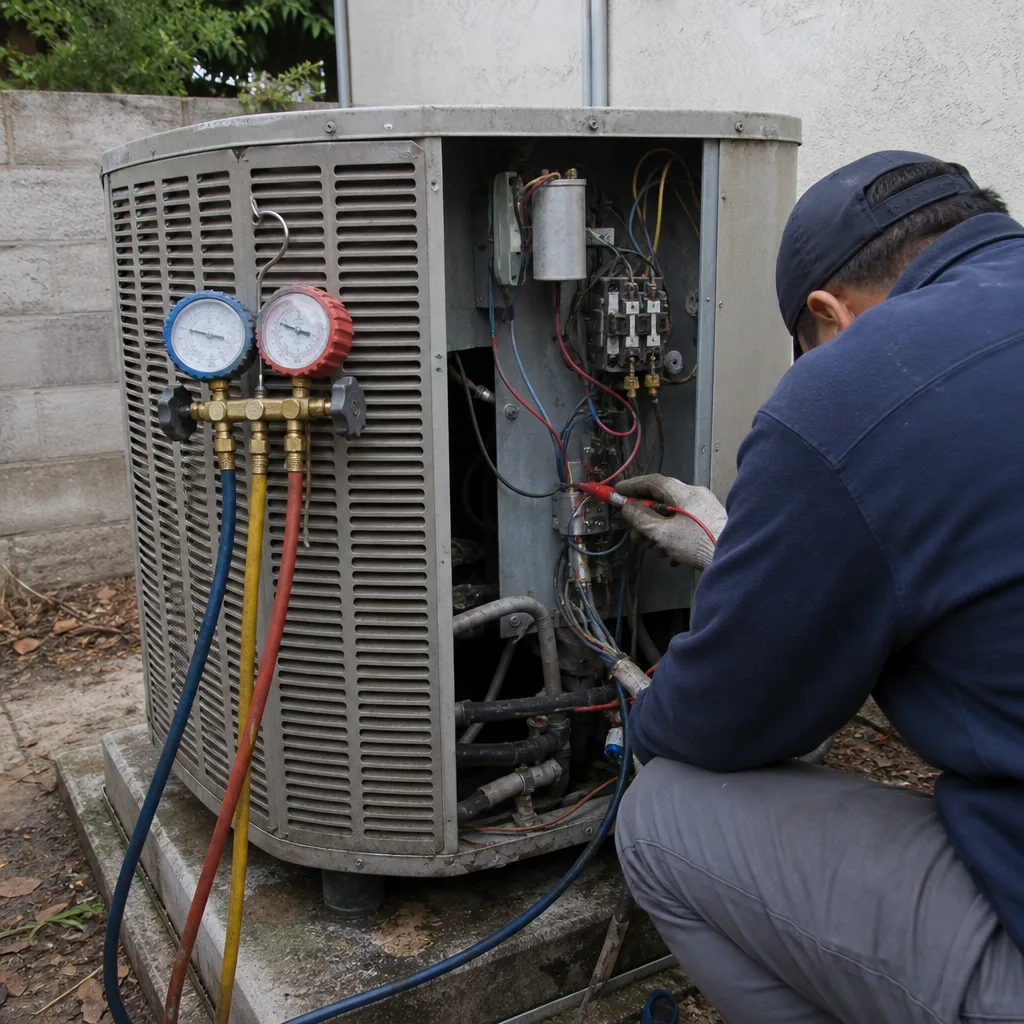
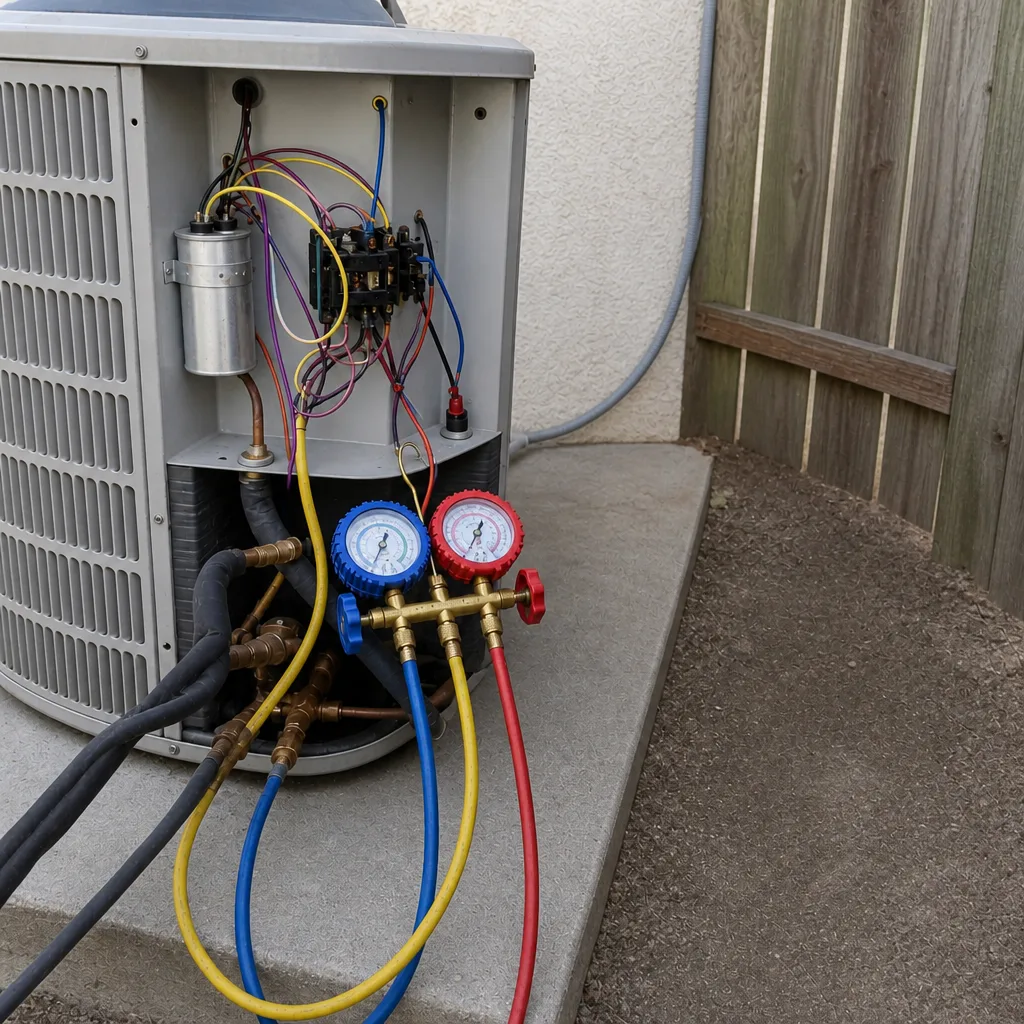
Because a system can be cooling and still be wrong. Refrigerant charge is set by weight or by subcooling and superheat readings on manifold gauges, and getting it right takes time – typically 20 to 40 minutes of running the system under load and dialing in the charge against the manufacturer’s spec. A crew that’s running behind or working in a hurry can top off “close enough” and move on. The system cools. The homeowner is happy for the first month. Then summer peaks, the compressor starts working against an off-spec charge, and the symptoms appear: shorter cycles, higher amp draw, slowly climbing bills.
Here’s how you request an accurate reading without sounding accusatory:
- Ask the technician to record the ambient temperature, suction line pressure, liquid line pressure, superheat, and subcooling on the service ticket.
- Ask them to verify those numbers against the nameplate or installation manual spec for the exact model of your unit (whether it’s a Goodman, Rheem, York, or Daikin unit, every manufacturer publishes this).
- Ask for the reading in writing, either printed or emailed, so it’s in your file.
- If the numbers are off spec, ask them to recover, evacuate, and recharge to the correct weight.
A properly trained technician with up to 10 years of experience will do this without complaint – it’s standard practice. If you hear excuses, that’s information too. Our team handles AC repair in Inglewood and installation follow-ups routinely, and we always put the gauge readings on the ticket.
How do you read your thermostat and air handler to build a factual case?
Before you call the installer, spend a week collecting simple data. Vague complaints get vague responses. Specific data gets a technician scheduled. Here’s what to record:
- Thermostat set point and actual room temperature, twice a day, ideally morning and late afternoon when the load is highest. Take a photo of the display each time.
- Cycle times – when the system starts and when it stops. Note three consecutive starts and stops on a warm day. Short cycling shows up clearly in the pattern.
- Room-by-room temperature readings using a $10 infrared thermometer or a cheap digital room thermometer. Note the biggest gap between rooms.
- Filter condition – photo of the filter when new and one week later, so you can show it isn’t clogged.
- Air handler behavior – listen at the indoor unit. Is the blower running continuously while the outdoor unit cycles? Does the air handler shut off the same moment the outdoor unit does, or lag by 30 to 90 seconds (normal)?
- Electric bill comparison – pull the same month from last year, and the pre-install month, so you can show the delta clearly.
Put all of this in one email to the installer. Subject line: “Post-installation performance issue at [address] – documented readings.” Attach the photos. That email is the strongest tool you have, and it establishes your date of first report in writing.
What does your City of Inglewood installation permit inspection catch, and what does it miss?
A permitted AC installation in Inglewood triggers an inspection from the city’s building department. The inspector’s job is code compliance: electrical disconnect present and properly sized, equipment anchored and clearances maintained, condensate drain correctly routed and trapped, nameplate and permit visible, and the system’s maximum overcurrent protection device matching the manufacturer’s label. Those are real safety checks, and you should always confirm the permit was pulled before the crew arrives.
Here’s what the inspection will not typically catch, and where installation problems hide:
- Refrigerant charge accuracy – the inspector verifies the system runs, not that the charge is within subcooling spec.
- Duct sizing and airflow balance – unless the permit explicitly covers ductwork, room-by-room airflow is not checked.
- Load calculation accuracy – the inspector doesn’t re-run the Manual J to confirm the unit is the right size for the house.
- Static pressure reading – a system with too much static pressure from restrictive filters or tight returns can pass inspection and still run inefficiently.
- Operating temperatures under peak load – an inspection on a cool morning won’t reveal a system that struggles at 95 degrees.
This is why permit inspection and performance verification are two different things, and you want both. Ask the installer for their documentation of load calculation, refrigerant charge reading, and airflow metrics. If they hand it over without fuss, you’re working with the right company. If not, that tells you something too.
Warranty call or installer callback: which is it, and how do you phrase the conversation?
This is the question most homeowners get wrong, and it costs them money. The distinction:
- Installer callback – the problem is caused by installation work, not the equipment. Callback work should be fixed at no charge by the installing contractor. Examples: improper charge, airflow restriction from install work, improperly sealed duct joints, wiring errors, thermostat misconfiguration.
- Warranty call – the problem is a defective part or manufacturing issue covered by the manufacturer’s warranty. The installer (or another authorized service provider) files the claim, replaces the part, and the manufacturer covers the part; labor may be covered or may not, depending on the warranty terms.
Here’s exactly how to phrase the call:
- Open with the date and address: “This is [name] at [address]. We had a system installed on [date] and it’s developed an issue I can document.”
- State the symptom and evidence: “It’s short cycling – I have photos of the thermostat showing a 5-minute cycle three times yesterday.”
- Ask the diagnostic question, not the accusation: “Can you come out and check refrigerant charge and airflow readings to tell me whether this is a manufacturer issue or an installation adjustment?”
- Note the date they schedule in writing, and put the words “callback” or “warranty” in the email confirming the appointment.
That phrasing gets you a scheduled technician instead of a phone debate, and it puts the diagnosis on the installer rather than on you.
When should you repair the installation versus replace the equipment?
Almost never replace a brand-new system. If your AC was installed within the last 12 months and the problem traces to installation, the answer is always repair and correct, not replace. The equipment is fine; the setup is wrong. Where homeowners get talked into replacement too early is when a company that didn’t do the install tells them the unit is “bad” without documenting the readings that would show whether the charge, airflow, or ductwork is at fault.
The replace conversation makes sense when:
- The system is beyond its expected service life and the compressor or coil is failing.
- Documented load calculation shows the unit is significantly oversized or undersized – correctable through replacement, but only if the replacement is properly sized.
- Repeated repairs on the same component suggest a manufacturing defect that requires a full manufacturer claim.
If you want an honest read on whether you’re facing a repair or a replacement, our team gives free estimates and we’ll tell you what the system needs, not what costs more. We also handle furnace repair and full furnace replacement for Inglewood homeowners, so if your heating system is also due for attention, one visit can cover both.
Common Mistakes to Avoid
- Waiting more than 90 days to report a symptom. The sooner you notify the installer in writing, the stronger your claim on the installation warranty window. Document day one and email it.
- Accepting “it’s normal” for a system that short cycles. A properly sized and charged system in Inglewood’s summer heat should run long, steady cycles – not 15 on and 10 off. Insist on gauge readings.
- Comparing your bill to your neighbor’s. Square footage, insulation, window type, and occupancy vary too much in Inglewood’s mix of older bungalows and newer construction. Compare against your own pre-install baseline.
- Letting a contractor skip the permit. Permits exist for a reason. If your installer didn’t pull one, that’s a red flag and an inspection problem waiting to surface when you sell the home.
- Blocking returns with furniture or rugs. A return air register that’s covered by a sofa or a floor rug starves the system of airflow and mimics the symptoms of a bad install. Check every return in the house before calling anyone.
- Filing a warranty claim before checking for installation errors. A warranty claim on a defective part is fine, but if the real cause is installation, you’ll pay for the part swap and still have the problem. Diagnose first.
- Hiring a company that won’t touch your brand. If your system is a Goodman, Rheem, York, or Daikin and a contractor says “we don’t work on those,” keep calling. Any competent installer should be able to read the nameplate and get the manufacturer spec for the equipment that’s already in your home.
When to Call a Professional
Call a professional the moment you see or smell anything that suggests refrigerant, electrical, or airflow problems you can’t see with your eyes. Refrigerant under pressure is dangerous; opening a system yourself voids the warranty and risks injury. Electrical components inside the air handler and condenser carry high voltage. Airflow problems require instruments – a manometer for static pressure, a balometer for room airflow – and a technician with up to 10 years of experience can measure them accurately in a single visit.
Symptoms that warrant a call right away: short cycling, refrigerant smell, unusual noise from the outdoor unit, water pooling near the air handler, a room that’s more than 5 degrees off from the rest, and any breaker that trips when the system starts. Call (866) 942-9087 for a free estimate. AC Repair Inglewood offers free estimates in Inglewood and can work with your equipment regardless of whether the brand is Carrier, Trane, Lennox, Goodman, Rheem, York, Daikin, Bryant, or American Standard. Our technicians have up to 10 years of experience, and we handle ac installation as one of our three core services – not as a side offering. For a wider view of what we cover across the area, see our Inglewood page.
See the difference
 Before
 After
 Before
 After
 Before
 After
Frequently Asked Questions
Most installation-related problems show up between 30 and 90 days after the job, once the system has run through a few weeks of real summer load. Some – like a bad thermostat setting or a poorly sealed duct joint – show up within days. The important thing is to report the symptom in writing as soon as you notice it, so your installation warranty clock is documented. Call (866) 942-9087 if you want us to come out and check what’s actually happening.
Constant running is normal on a 95-degree Inglewood afternoon, but not when the outdoor temperature is in the 70s or when the system runs 45 minutes to drop the house 2 degrees. Long steady cycles are actually a good sign for efficiency, but “constant” means the system never satisfies the thermostat. That points to refrigerant charge, airflow, or a load calculation issue. Have a technician check refrigerant subcooling and room airflow before assuming the equipment is defective.
Yes. The warranty is the manufacturer’s promise on the equipment, not the installer’s discretion. What matters is that you documented the report date and the symptoms. Keep every email and every service ticket in a file. If the installer is unresponsive, you can typically have another authorized service provider file the claim – the manufacturer pays the parts, and the labor coverage depends on the warranty terms. Having a written record of your report helps either route.
A faint chemical smell during the first few days can come from residual brazing flux burning off, but a smell that persists beyond two weeks or shows up fresh each time the system starts is likely a refrigerant leak at a joint. Refrigerant is a hazardous material and you shouldn’t investigate it yourself. Call the installer back, describe the smell, and ask them to do a leak check with an electronic detector. If they can’t get out quickly, call (866) 942-9087 – we can confirm the leak and document it for your installer’s warranty file.
No. The city inspection verifies code compliance – electrical disconnect, condensate drain, equipment anchorage, clearances, and permit visibility. It doesn’t typically verify refrigerant charge, room airflow, or load calculation accuracy. Those require a technician’s manifold gauges and airflow instruments. Always confirm the permit was pulled, but don’t assume the inspection is a performance audit. It isn’t.
Ask for the diagnostic readings in writing, and get a second opinion before accepting a brand excuse. A properly installed system from any of the major brands – Goodman, Rheem, York, Daikin, Carrier, Trane, Lennox, Bryant, or American Standard – should run to spec. If the charge is off, ductwork is restricted, or the unit was sized wrong, the brand is not the issue. The installation is. Our technicians have up to 10 years of experience and can give you a clear read on whether you’re facing a repair, a warranty claim, or an installation callback.
The Bottom Line
If your AC was installed within the last few months and something feels wrong, the odds are against a defective unit. Improper refrigerant charge, undersized or leaky ductwork, short cycling from an oversized system, and airflow restrictions account for the vast majority of post-installation problems in Inglewood homes. Document the symptoms with dates, thermostat readings, and photos. Put your report in writing to the installer. Ask for gauge readings and airflow numbers in writing. And if your installer won’t produce them, get a second opinion before you spend money on anything else. The system you paid for should work correctly, and getting it corrected now is almost always cheaper than living with the problem for a season.
Contact Us
Whether you’re troubleshooting a new install or you’re past the warranty window and need an honest diagnosis, we can help. We service nine of the most widely installed HVAC brands in residential homes, we handle both ac installation in Inglewood and full furnace work, and we give you the readings in writing so you can make the call yourself. Call (866) 942-9087 for a free estimate. We answer 24/7. Fast dispatch from 7am to 7pm, Sunday through Friday.
Written by the team at AC Repair Inglewood.